Sunday, January 18, 2015

North African Butternut Squash Soup


I have found that my tastebuds are getting more adventurous as I get older.  I have my basic butternut squash soup recipe which is delicious but sometimes it's fun to switch things up a little.  I'm so glad I tried this recipe.  It is a treat to the eyes as well as the tastebuds - colorful and delicious and provides lots of healthy vegetables (some kale or lentils might be good additions too).

A note about the ingredients:  The small cinnamon stick gives it just a hint of cinnamon flavor without overpowering.  The harissa is a chili paste that can be found in middle eastern markets and gives a nice depth of flavor.  This soup also has ground turmeric.  Hopefully you've heard about the health benefits of turmeric.  It's a superfood spice that's getting a lot of press lately.  It can reduce inflammation and has many other health-protecting properties.

Feeling adventurous in the kitchen?  Give this soup a try - your body will thank you!

North African Butternut Squash Soup
from The New Mediterranean Diet Cookbook by Nancy Harmon Jenkins
Makes 6 servings

2 Tablespoons extra-virgin olive oil
1 medium carrot, chopped
1 celery stalk, chopped
1 garlic clove, chopped
1 sweet red pepper, chopped
1/2 to 1 tsp harissa, or 1/2 tsp crushed red pepper flakes
6 cups cubed butternut squash or pumpkin (about 1 1/2 pounds)
1 14.5 ounce can plum tomatoes, chopped with their juice
2 bay leaves
1 short piece of cinnamon stick
1/2 teaspoon ground turmeric
sea salt and freshly ground black pepper, to taste
2 cups water or chicken stock
1 or 2 tablespoons fresh lemon juice
2 tablespoons finely chopped fresh cilantro, optional

Combine the olive oil, carrots, celery, and garlic in a heavy-duty stock pot set over medium-low heat.  Cook, stirring occasionally, until the vegetables are soft but not brown, about 10 minutes.  Add the chopped pepper,  the harissa or crushed red pepper, and the butternut squash and cook for about 5 minutes.  Add the chopped tomatoes, bay leaves, cinnamon, turmeric, salt and pepper to taste, and 2 cups of water or chicken stock.  Bring to a simmer and cover the pan.  Let simmer about 20-30 minutes or until the squash is very soft.  If desired, blend the soup with a blender or a stick blender (I left mine chunky).  Add lemon and cilantro and adjust seasoning if needed.

Wednesday, July 9, 2014

Purslane - is this super weed growing in your garden?


Purslane is a common weed found in most of our yards and gardens.  I call it a superweed, not because it is unmanageable, but because it is a nutritional powerhouse!

Check out these nutrition facts:

-purslane has more omega-3 fatty acids (in the form of ALA) than any other plant food.  100 grams of fresh purslane contains 350 mg of ALA.  Increasing our intake of omega-3's has been linked to better heart health and decreased systemic inflammation.

-it is a good source of many vitamins and minerals including vitamins C and E, riboflavin, beta carotene, iron, magnesium, manganese, potassium and calcium.

-purslane is also high in dietary fiber, contains antioxidants and is reported to contain compounds which help with depression.

Purslane growing among the thyme and rosemary.

In my garden, I practice selective weeding.  I'll pull other weeds and leave the purslane to grow.  It is actually beneficial to the surrounding plants as it provides a great edible ground cover which helps retain soil moisture and prevents other weeds from taking over.  It grows low to the ground so it doesn't impede my other plants from getting the sunlight they need - and it's such a cute and happy looking plant!

Purslane is an annual plant that reseeds itself each year.  The seedlings will appear when the soil warms to 76 degrees F.  The plant will grow in just about any soil conditions, even in the cracks of the sidewalk, and the seeds can remain viable in undisturbed soil for more than 30 years.  I will allow some of my purslane to mature and develop seeds to ensure that I will have more purslane next year.

I think purslane is delicious.  It has a mildly tart lemony flavor. I eat purslane straight from the garden sometimes, but most of the time I'll add it to a salad along with other greens.  (Only harvest purslane in areas which you know have not been chemically treated.)  The leaves, tender stems and flowers are all edible.  Just pinch off the stems, or pull the entire plant and cut off the roots if you are trying to control the plant.  

Dress your purslane salad simply with olive oil, lemon juice, salt and pepper.  Or add it to potato salad, soups, or anywhere you would use spinach or other greens.

In the case of purslane,  I'm happy to ask my kids, "have you eaten your weed today?"

Purslane as ground cover under my tomato plants.

Sources:
http://www.naturalhealth-solutions.net/healthy-eating/powerhouse-of-nutrition-purslane
http://www.nutrition-and-you.com/purslane.html
http://www.canadiangardening.com/plants/native-plants-and-wildflowers/purslane-an-edible-groundcover/a/31791

Thursday, June 12, 2014

Colorful Coleslaw


With the arrival of summer and the season of barbecue, I thought I would share my favorite recipe for healthy colorful coleslaw.   Serve alongside burgers or pulled pork.  Happy Summer!

Coleslaw
adapted from Williams-Sonoma Essentials of Slow Cooking
Makes 8 servings

1/2 cup avocado oil mayonnaise
1 Tablespoon raw honey
2 teaspoons apple cider vinegar
1 teaspoon celery seed
4 cups shredded green and/or red cabbage
2 tablespoons sweet or red onion, grated (optional)
2 carrots, grated
salt and pepper, to taste

In a small bowl, mix together the mayonnaise, honey, cider vinegar, and celery seed.


In a large bowl, toss together the cabbage, onion, and carrot.  Add the dressing, salt and pepper to taste and toss well.

Thursday, November 21, 2013

Best Eggplant and Lentil Stew


This past summer, I grew eggplant successfully for the first time.  Maybe it was the new raised beds we made with fresh dirt and compost that did the trick.
  

Or maybe it was the ample rain we got throughout the season. (We barely had to water the plants all summer!)


In years past, my eggplant just didn't produce, but in the summer of 2013 we had the nicest crop of tomatoes, peppers, and eggplant that I've ever seen.  I didn't do anything differently, and I don't ever use fertilizers or pesticides.  I'm always amazed at how many tomatoes can grow on just one plant without any fussing at all.  Tying up the tomatoes was the only thing I made sure to do.


 Since I'd never been able to grow eggplant in any quantity before, I was at a loss of what to do with them.


Then I found a recipe for Turkish Lentil and Eggplant Stew at Simply Recipes.  The recipe is similar to another favorite of mine - Lively Yourself Up Lentil Soup.   I made a few changes to Elise's recipe and the result is a new favorite meatless lentil soup!  I recommend doubling the recipe and freezing to enjoy the goodness all winter long.

Eggplant and Lentil Stew
Serves 4-6

1 1/2 pounds eggplant, cut into cubes (Can substitute butternut squash or sweet potato)
1/2 cup brown or green lentils
1/4 cup extra virgin olive oil, plus more for roasting eggplant
1 medium onion, diced
2 large cloves garlic, minced
1 tablespoon tomato paste
1 quart whole tomatoes, undrained (or 4 large fresh tomatoes, seeded, peeled and chopped)
1 jalapeño pepper, some or all of the seeds removed for desired heat, minced
2 sprigs fresh oregano, or 1/2 tsp dried
pinch of crushed red pepper flakes, or to taste
1 tsp salt
1/2 tsp pepper
1 Tablespoon pomegranate molasses, optional
2 tablespoons parsley, chopped
Two big handfuls of hearty greens such as kale or swiss chard, stems removed and leaves chopped (optional)
2 tablespoons fresh cilantro for garnish, chopped (optional)

1.  Preheat the oven to 400 degrees F.  Place the eggplant cubes in a colander and sprinkle with salt.  Let sit in the sink for 1/2 hour while the oven is preheating.  Spread the eggplant out onto a baking sheet and drizzle with ample amount of olive oil.  Bake until eggplant is soft and beginning to caramelize.

2.  Check that the lentils do not contain any small rocks or dirt.  Place the lentils in a saucepan add enough water so that the lentils are covered by an inch of water.  Bring the lentils to a boil, then reduce heat and simmer until just tender, about 15-20 minutes. Drain.

3.  Heat 1/4 cup olive oil in a pot over medium heat.  Add the onions and jalapeño and cook until soft.  Add the garlic and cook for one minute.  Add the tomato paste and cook until heated through.  Add the tomatoes, cooked lentils, oregano, crushed red pepper, salt and pepper, pomegranate molasses, and parsley and simmer for 30 minutes.  Add water or chicken stock to obtain the desired thickness of the stew.   Add eggplant and greens, if using, and continue to cook until greens are wilted and tender, about 10 minutes.  Adjust seasonings to taste.  Remove from heat, pull out oregano stems and stir in the fresh cilantro, or garnish each bowl with cilantro and a drizzle of olive oil to taste. (I add extra cilantro to my bowl!)

Thursday, January 31, 2013

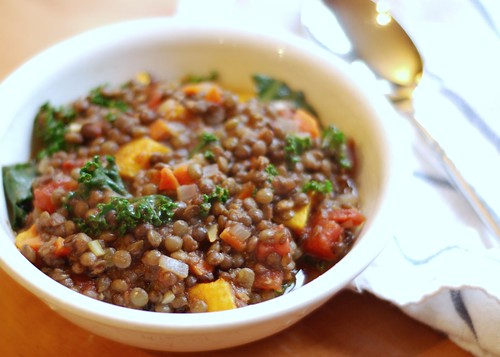
Lentil and Kale Soup with Butternut Squash

Lively Yourself Up Lentil Soup

It's a dreary and cold day in late January and maybe you have just spent the last couple of days unintentionally loading up on sugary carbs and now you're feeling sluggish and generally crappy.  What do you do now?  {Let's just replace all those "you"s to "I"s and we'll get down to the real truth.}

Make some of this lentil soup!  It's meatless - vegan actually - unless you decide top with a poached egg which is also quite good.  It's colorful and delicious and every bite gets you back to feeling good again, even though it's still late January and still cold and dreary.

A few important items about this soup:

1.   Try to find French green lentils, also called Puy lentils, or black beluga lentils for this soup.  They hold up to cooking and don't break apart and turn to unrecognizable mush like other lentils have a tendency to do when cooked.  I have great luck finding these varieties in the bulk section of groceries like Whole Foods.

2.  Substitute roasted sweet potato for the butternut squash if you desire.

3.  Any hearty green will work.  I prefer kale in this recipe, but I've also used swiss chard which is also quite good.  The kale is just a bit heartier and chewier and stays defined in the soup a bit better.

4.  The leftovers may not be quite as colorful as the kale tends to turn less green as it sits, but it will be just as delicious as the day it was made.

5.  The leftover soup can be frozen quite successfully.

Lentil Soup with Butternut Squash and Kale
adapted from 101Cookbooks
Serves 6-8

1 medium butternut squash, peeled and diced to 1/2" cubes, optional
2 cups black beluga lentils or green French lentils, picked over and rinsed
2 tablespoons extra virgin olive oil, divided
1 large onion, chopped
2 carrots, finely chopped
1 clove garlic, minced
2 tsp coarse salt
ground black pepper to taste
1 tsp dried marjoram
1 28-ounce can crushed tomatoes
2 cups water
3 cups of a big leafy green (chard, kale, etc), rinsed well, deveined, chopped

Preheat oven to 375 degrees F.  Place the diced squash on a sheet pan lined with foil.  Drizzle with olive oil and sprinkle with salt and pepper.  Roast for 30 minutes or until tender.  This can be done a day ahead.

Bring 6 cups of water to a boil in a large saucepan, add the lentils, and cook for about 20-30 minutes, or until tender. Drain and set aside. Meanwhile, heat the oil in a heavy soup pot over medium heat, then add the onion, carrots, garlic, salt, pepper and marjoram and sauté until tender, about 5 minutes. Stir in the tomatoes, lentils, and water and continue cooking for about 10 more minutes, letting the soup come back up to a simmer. Stir in the chopped greens and roasted squash, and simmer another minute or two until kale is wilted and squash is heated through.  Adjust seasoning if desired.

Tuesday, April 3, 2012

Escarole with Cannelloni Beans


Believe it or not, there are times when sweet just doesn't cut it for me.   Sometimes I just need warm and healthy and wholesome and filling and slow-cookin', but not heavy.  This dish fills the requirement perfectly.

Start the night before and soak your beans in cold water overnight.  Then drain and rinse the beans.  Add the beans to a stockpot with some chicken or vegetable stock, water, and olive oil.  Add some onions, carrots, garlic, and sage and simmer away until the beans are tender (1 1/2 - 2 hours).


When the beans are tender, remove from the heat and remove and discard any large pieces of onion, garlic, and sage.


In a large skillet, heat the remaining olive oil, then add the garlic, red pepper flakes and pancetta, then the escarole.  Cook 5 minutes until escarole is wilted.


Add the tomatoes and seasoning...


...then the beans.  Sprinkle with lemon and adjust seasonings.  Serve with a drizzle of olive oil and parmesan shavings and feel good!


Escarole with Cannellini Beans


  • 1 lb. dried cannellini beans or Great Northern beans
  • 2 cups chicken or vegetable broth
  • 1/2 cup olive oil, plus more for serving
  • 2 yellow onions, quartered
  • 2 carrots, cut into 2-inch pieces
  • 8 garlic cloves, 4 left whole, 4 minced
  • 2 fresh sage sprigs
  • 1/4 tsp red pepper flakes (I used a scant 1/4 tsp)
  • 2 oz. pancetta or unsmoked bacon, chopped (optional)
  • 2 heads escarole, about 2 lb. total, cut crosswise into strips 2 inches wide
  • 1 can (14 1/2 oz.) diced plum tomatoes, preferably San Marzano, drained
  • 1 tsp. salt, plus more, to taste
  • 1/2 tsp. freshly ground pepper, plus more, to taste
  • Juice of 1 lemon
  • Extra-virgin Olive oil for drizzling and shaved parmesan for garnish


Pick over the beans, removing any misshapen beans or grit. Rinse under cold running water. Put the beans in a large bowl, add cold water to cover by at least 2 inches and let stand at room temperature overnight. Alternatively, for a quick soak, put the beans in a large pot, add water to cover by at least 2 inches and bring to a boil. Remove from the heat, cover and let soak for 1 hour. Drain and rinse the beans.

Stovetop method: In a large Dutch oven, combine the beans, the broth and 1/4 cup of the olive oil. Add cold water to cover the beans by about 1 1/2 inches. Add the onions, carrots, whole garlic cloves and sage. Bring to a boil over high heat, reduce the heat to low, partially cover and simmer gently until the beans are very tender, 1 1/2 to 2 hours. Remove the onions, garlic cloves and sage and discard.

Slow-cooker method: In a slow cooker, combine the beans, the broth and 1/4 cup of the olive oil. Add cold water to cover the beans by about 1 1/2 inches. Add the onions, carrots, whole garlic cloves and sage. Cover and cook according to the manufacturer's instructions until the beans are very tender, about 4 hours on high or 8 hours on low. Remove the onions, garlic cloves and sage and discard.

About 30 minutes before the beans are done, in a large fry pan over medium-high heat, warm the remaining 1/4 cup olive oil. Add the minced garlic, red pepper flakes and pancetta and sauté until fragrant, about 30 seconds. Add the escarole and sauté until the leaves begin to wilt, about 1 minute. Add the tomatoes, the 1 tsp. salt and the 1/2 tsp. pepper and cook, stirring occasionally, until the leaves have softened and the mixture is reduced to about one-third, 5 to 7 minutes.

When the beans are done, add the escarole mixture and stir, breaking up some of the beans with the back of the spoon to thicken the mixture slightly. Stir in the lemon juice. Season with salt and pepper. Serve immediately, passing the remaining olive oil and shaved parmesan at the table. Serves 6 to 8.

Tuesday, November 8, 2011

Best Cauliflower Soup


Recently, I found myself with a refrigerator full of cauliflower. You may be wondering how, exactly, one finds themselves with a boatload of cauliflower. Well, I belong to a CSA and this year, I volunteered to be one of their drop-off sites where people from my area come once a week to pick up their box of local organic vegetables.

Once in a while, a CSA member will not pick up their box of veggies and I am left to give it away or use it. You may think this is a great deal for me - it is, except when you find that you have more cauliflower (and apples and acorn squash) than your family can eat (just one head of cauliflower is probably more than my family wants to eat)! 

I hate to waste anything and start trying to find ways that I can cook with it and/or freeze it so I can enjoy the produce right through the long months of winter. Making soup is the perfect solution and I absolutely loved this soup - I've made two double batches of it so far!

I've eaten this soup for dinner, I've eaten it for lunch, and I've even eaten it for breakfast! Soup is a surprisingly satisfying mid-morning breakfast served with a piece of buttered multi-grain toast. 

And don't be surprised if you see a few more soup recipes here in the future. I've got some good ones to share with you!

Cauliflower Soup
from Ree Drummond at Pioneer Woman Cooks

1 stick Butter, Divided
1/2 whole Onion, Finely Diced
1 whole Carrot Finely Diced
1 stalk Celery, Finely Diced
1 whole (to 2 Whole) Cauliflower Heads (roughly Chopped)
2 Tablespoons Fresh Parsley (chopped)
2 quarts Low-sodium Chicken Broth Or Stock
4 Tablespoons All-purpose flour or gluten free flour
1/4 to 1/2 teaspoon red cayenne pepper, to taste
1/2 cup heavy cream,
2 - 4 teaspoons salt, to taste
Shredded cheese for garnish (also optional)

In a large soup pot or dutch oven, melt 4 tablespoons butter. Add the onion and cook for a few minutes, or until it starts to turn brown.

Add the carrots and celery and cook an additional couple of minutes. Add cauliflower and parsley and stir to combine.

Cover and cook over very low heat for 15 minutes. After 15 minutes, pour in chicken stock or broth. Bring to a boil, then reduce heat and allow to simmer.

In a medium saucepan, melt 4 tablespoons butter. Whisk in the flour and cook about one minute. Add the cream and whisk to combine. Add mixture to the simmering soup and allow to simmer for 15 to 20 minutes. Add more stock if necessary to achieve desired consistency.  Check for seasoning. Blend with a stick blender to desired consistency, or puree half the soup in a blender and add back to rest of the soup for a creamy and chunky soup (I like to have some big pieces of tender cauliflower in the soup).

Sprinkle some grated cheese on top, if desired.  Or sometimes I'll sprinkle with a little curry powder for an Indian twist.

Serve immediately, for breakfast even!

Soup can be refrigerated for one week, or frozen for 6 months.